
From 31 October extensions and schemes under 10 homes go to officers, and ward councillors can no longer call an application in. Council votes on 15 October.
From Saturday 31 October, most planning applications in Basingstoke and Deane must be decided by council officers, and your ward councillor will no longer be able to call one in to committee. The full council votes on the change on Thursday 15 October.
The rules are not the council’s choice. The government’s National Scheme of Delegation comes into force in England on 31 October 2026. The council’s report to Council says it “has no discretion about implementing the Regulations”. If councillors vote the changes down, the Monitoring Officer has the power to write them into the constitution anyway.
The report calls it “a seismic change for all customers and those affected by planning applications”.
What changes on 31 October
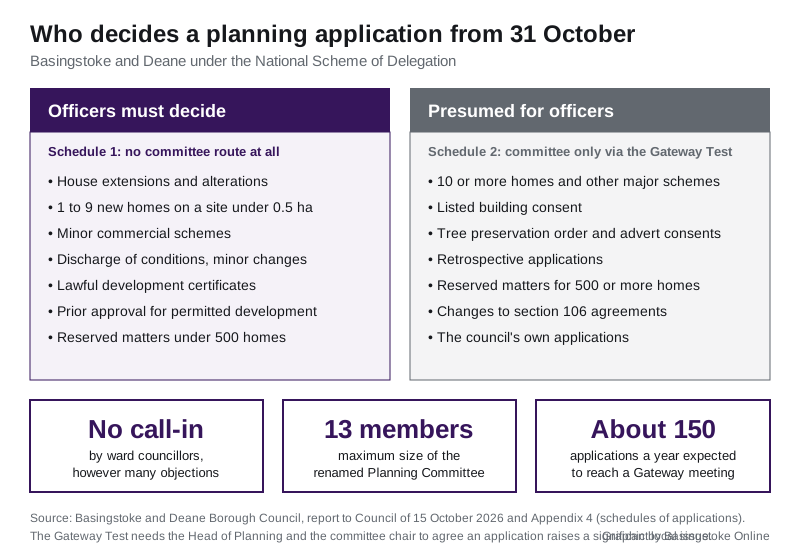
The regulations split applications into two schedules. The council’s Appendix 4 lists them in full.
Schedule 1 must be decided by officers in every case. It includes:
- house extensions and alterations
- minor residential schemes of one to nine homes on a site under 0.5 hectares
- minor commercial development
- discharge of conditions and non-material amendments
- lawful development certificates
- prior approval for permitted development
- reserved matters for outline permissions under 500 homes
Schedule 2 is presumed to go to officers too, but can reach the committee through a new “Gateway Test”. It covers:
- everything that is not householder, minor commercial or minor residential, so any scheme of ten homes or more
- listed building consent
- tree preservation order and advertisement consents
- retrospective applications
- reserved matters for outline permissions of 500 homes or more
- changes to section 106 agreements
The Gateway Test
A Schedule 2 application can only go to committee if two people agree. They are the Nominated Officer, which will be the Head of Planning and Infrastructure, and the Nominated Member, which will be the chair of the committee. Under the rules of operation they will meet fortnightly if needed.
To pass the test, an application must raise at least one of:
- “one or more issues of economic, social or environmental significance to the local area”, or
- “one or more significant planning matters having regard to the development plan and any other material considerations”
Government guidance says a scheme that broadly complies with a site allocation in the Local Plan is unlikely to count as a significant planning matter. Nor is a scheme where a highways or flood objection has been resolved to the consultee’s satisfaction.
If the two cannot agree, the application goes to the officer. The report is blunt about what is lost:
- “There is no ability for a Ward Councillor to call in an application to the Committee for determination irrespective of the number of representations received.”
- Schedule 1 applications cannot go to committee at all, “and this will include minor residential schemes for less than 10 dwellings”.
- “There will be no equivalent of calling to committee for determination an application where the officer recommendation is for refusal.”
Every Gateway decision has to be recorded with reasons, published on the council’s website and reported to the committee quarterly.
Triage to keep the numbers down
The council wants to filter some Schedule 2 cases out before they reach a Gateway meeting. Under its proposed rules, the Planning and Development Manager can send straight to officers:
- listed building applications, unless the building is Grade I or II* or Historic England objects
- advertisement consents
- tree preservation order consents
- changes to section 106 agreements that do not touch the main obligations
The report estimates that with triage about 150 applications a year would reach a Gateway meeting, around five or six a fortnight. Without it, based on last year’s caseload, the figure would be about 400, or 15 a meeting. Most of the extra cases would be listed building applications tied to a householder scheme, which officers say would slow routine decisions and risk complaints.
Other changes in the same vote
The report asks the council to:
- rename the Development Control Committee the Planning Committee, as the Planning Advisory Service recommended
- cap the committee at 13 members, which the regulations require
- adopt a new Planning Code of Conduct, replacing the Probity in Planning code, with rules on lobbying officers
- define the council’s “own interest” applications as those from heads of service, planning staff and councillors, so they can still be referred to committee for transparency
- review the rules after six months
The Development Control Committee considered its own version of the report on 7 October, and town and parish councils have been told the changes are coming. Consultation on applications does not change: parish councils, neighbours and businesses will still be asked to comment, and their comments still count.
What it means for you
- If you object to a neighbour’s extension, the decision is now an officer’s whatever you or your councillor say. Written objections still go on the file and must be considered.
- If you object to a scheme of ten or more homes, the route to committee is the Gateway Test. Objections that raise a genuinely local economic, social or environmental issue are what the test looks for. Numbers alone are not enough.
- If you are applying, small schemes should be quicker. The report says the change is meant to shift “routine, policy-compliant applications to planning officers”.
- If you follow committee, watch for the published Gateway records from November. They will show which schemes were kept from the committee and why.
The stakes are already high. Our August report found the council within two lost appeals of the government’s designation threshold, which would let applicants bypass it altogether: Basingstoke planning: council close to losing big decisions. The report to Council says that failing to run the new system smoothly “could increase the risk of designation”.
Council meets at 6.30pm on Thursday 15 October at the Civic Offices. The agenda also carries the 2027/28 calendar of meetings. For how applications near you are progressing, see our planning news page.
Have your say