
Six lost appeals put the council at 8.95% against a 10% government limit. Two more could take it to 11.9% and let developers bypass the council entirely.
Basingstoke and Deane is close to losing the right to decide its own biggest planning applications. Six major appeals have gone against the council in the current government monitoring period, putting it at 8.95% against a limit of 10%. Two more appeals are still to report, and if both are lost the figure becomes 11.9%.
The council has set this out itself, in a report going to the Development Control Committee on Wednesday 9 September. It is titled Quality of Decision on Major Planning Applications and it does not soften the position: the council is “now close to exceeding the Government’s 10% performance criteria”.
What happens if it goes over
If the Ministry of Housing, Communities and Local Government designates a council for poor quality decisions on major applications, developers get a choice. They can send an application for major development straight to the Planning Inspectorate instead of to the council.
The report spells out what that means locally:
- decisions on the borough’s largest schemes would not be taken here
- the council would have “limited input into the final wording of conditions and any relevant Section 106 Agreement requirements”, which is where affordable housing, school places and road contributions are secured
- the application fee would go to the Planning Inspectorate, not the council, hitting income budgets for 2027/28
- the council would still have to do the administration, including consulting neighbours
Designation normally lasts 12 months. The power comes from sections 62A to 62C of the Town and Country Planning Act 1990, inserted by the Growth and Infrastructure Act 2013.
The numbers
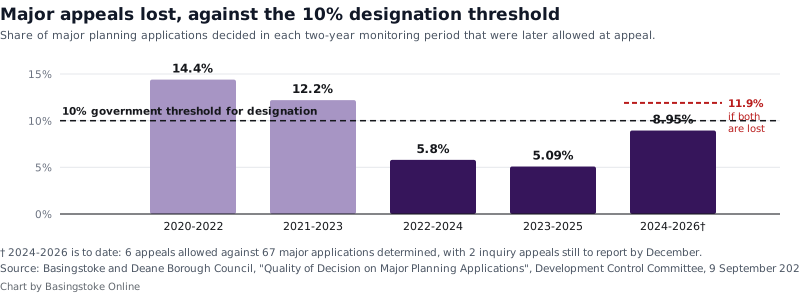
The measure is the share of major applications decided in a two-year window that are later allowed at appeal. The current window is April 2024 to March 2026, with appeals counted until the end of December 2026.
So far: 6 appeals allowed against 67 major applications determined, which is 8.95%. Two appeals remain outstanding, both public inquiries. One was heard in August and has not reported. The other is scheduled for November.
This is not new territory. The council failed the test twice before, at 14.4% for 2020-2022 and 12.2% for 2021-2023. On both occasions it argued exceptional reasons and was not designated. Performance then improved to 5.8% and 5.09% before slipping back.
The six schemes it lost
The council’s appendix lists every qualifying decision:
| Scheme | What was proposed | Decided by | Appeal allowed |
|---|---|---|---|
| Sapley Lane, Overton | 130 dwellings | Committee, against officer advice | 7 April 2026 |
| Land off West Ham Lane, Basingstoke | 44 dwellings | Delegated | 16 June 2026 |
| Land east of Sherfield Road, Bramley | 20 dwellings | Delegated | 28 January 2025 |
| Land north of The Chalet, Headley | 14 dwellings | Committee, as recommended | 15 August 2025 |
| Land at Lower Wyke | Solar farm | Committee, against officer advice | 11 June 2026 |
| Land north of Whitchurch station | Surface car park | Delegated | 26 May 2026 |
Three were delegated decisions taken by officers and three were committee decisions. Of the committee ones, two overturned an officer recommendation to approve.
Why the council keeps losing
The report’s own analysis is the interesting part. Inspectors have not been telling the council it was wrong about the harm. They have generally agreed with it, then decided the benefits outweigh it anyway.
The report calls this “a step change in how the harm is balanced against the benefits of delivering development and in particular new homes”.
Two examples make the point:
- At The Chalet, Headley, the council had previously won an appeal against nine homes on the same land. It refused 14 homes partly on that history. The Inspector allowed the 14 because the larger scheme triggered 40% affordable housing, six homes, which tipped the balance.
- At Sherfield Road, Bramley, the Inspector calculated that delay in delivering sites had cut the borough’s housing land supply to 2.78 years, agreed there would be landscape and conservation area harm, and allowed 20 homes anyway.
That housing land supply figure is the root of it. Without a five-year supply, national policy tilts decisions in favour of housing. The report says the “prolonged nature” of the shortfall means the council “has to accept the shortfall as being serious and significant”. It also points to the Government’s target of 1.5 million homes this Parliament and the new National Planning Policy Framework published in August.
That shortfall is not going away. A separate report to Cabinet the night before proposes restarting the Local Plan under the new planning system, which would delay adoption to 2029 and, in its own words, leave the borough without a five-year supply until then. We have covered that in full: the Local Plan delay.
One point in the council’s favour, which it makes itself: it has had no costs awarded against it. Applicants asked for costs in the Sapley Lane and Whitchurch car park appeals and the Inspectorate refused both. The council reads that as evidence its cases were reasonable even where it lost.
What the council is doing about it
Measures already taken include implementing recommendations from a Planning Advisory Service review in 2022, a follow-up review of the committee in 2024, extra committee training in November 2025 and mandatory committee training in June 2026.
Planned next steps in an evolving action plan:
- asking the Planning Advisory Service what more can be done and whether it can help up front
- external expert training for planning officers on critiquing appeal decisions, being arranged for autumn 2026
- a review of consultee input
- further training for Development Control Committee members
- a possible senior planner oversight group to review every major application
Because the losses this time span both officer and committee decisions, the report says the focus will be on training officers first, unlike previous rounds which concentrated on councillors.
What happens next, and when
Performance is only confirmed at the end of the monitoring period in December 2026. MHCLG would then write to the council, usually in March or April 2027, asking whether there are reasons it should not be designated. A final decision would follow in May or June 2027.
Designation is not automatic even if the threshold is breached. The report sets out three possible outcomes: no action, no designation but a monitoring period, or designation.
There is precedent for a short one. The report cites Fareham Borough Council, designated in December 2023 and de-designated in March 2024 after three months.
What it means for you
If a large scheme near you is refused, expect the applicant to appeal, and expect them to have a decent chance. Six of the last 67 major decisions have been overturned, and the reason is national policy, not local incompetence.
If designation happens, objecting gets harder. An application decided by the Planning Inspectorate is not debated in a public committee meeting in Basingstoke that you can attend and speak at. The report is candid that the council would have limited say even over the conditions attached.
Nothing is decided yet. The threshold has not been breached, two appeals could still go either way, and even a breach may not lead to designation.
The committee meets at 6.30pm on Wednesday 9 September in the Council Chamber at the Civic Offices, London Road. Development Control Committee meetings are open to the public, and the agenda and reports pack are published in advance. The same meeting takes the quarterly appeals report covering 1 May to 31 July 2026.
More on planning locally: our Basingstoke planning news page tracks live applications, and there is background on house prices and roadworks and travel.
Have your say