
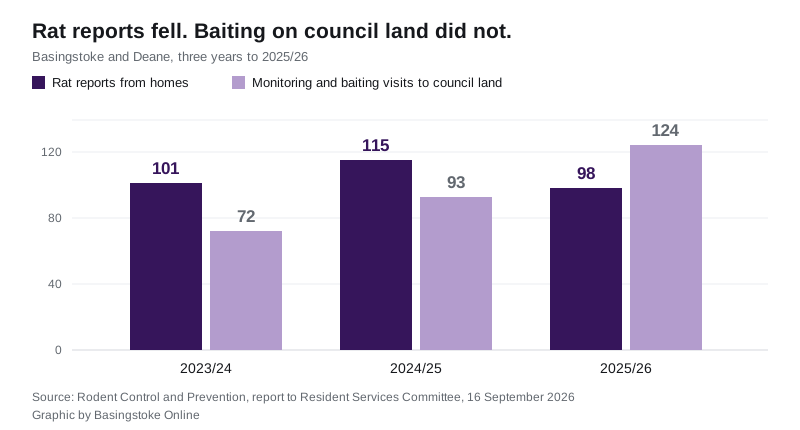
Council baiting on its own land rose from 72 visits to 124 in three years, almost all at the Leisure Park and outside the station. Reports from homes fell.
Councillors asked the borough council whether Basingstoke has more rats than it used to. The answer, published this week, is that reports from residents have gone down while the council’s own contractor is baiting its land far more often, and almost all of that extra work is happening in two places: the Leisure Park and the land in front of Basingstoke railway station.
The figures are in a report going to the Resident Services Committee on Wednesday 16 September. It was written after committee members raised “concerns regarding a perception of an increase in the rat population across the borough”. (Rodent Control and Prevention, 16 September 2026)
What the numbers show
Reports of rats made to the council’s Environmental Health team have not risen. Domestic reports fell last year, and commercial reports are at their lowest of the three years recorded.
| Year | Rat reports (domestic) | Rat reports (commercial) |
|---|---|---|
| 2023/24 | 101 | 8 |
| 2024/25 | 115 | 11 |
| 2025/26 | 98 | 5 |
The council’s appointed pest control contractor tells a different story. Its visits to homes climbed each year, and its monitoring and baiting of council-owned land rose by 72% over the same period.
| Year | Visits to homes | Surveys of council land | Monitoring and baiting of council land |
|---|---|---|---|
| 2023/24 | 122 | 23 | 72 |
| 2024/25 | 133 | 33 | 93 |
| 2025/26 | 153 | 13 | 124 |
The report is blunt about what is behind the rise on council land. It is “almost entirely a result of increased inspections at two sites, the Leisure Park and the land in front of Basingstoke Train Station”. The frequency of monitoring at both has gone up over the last two years.
Two other findings are worth pulling out. In the three years covered, no report has needed formal enforcement action against a property owner. And no report of rodent activity has been made at any borough play area, all of which are on a continual inspection programme.
The council spent £14,300 on it last year
Rodent control and prevention cost the council £14,300 in 2025/26, inside its approved budget. The duty behind the work is section 2(1) of the Prevention of Damage by Pests Act 1949, which requires the council to keep the borough free from rats and mice as far as is practicable.
There are limits on what that can mean in open space. The report says it is “not practical to deal with all sightings in areas such as woodlands, green buffer and water courses”, and notes a tension the council does not often admit to in public: measures taken to create habitat for wildlife also, by their nature, attract rodents.
Shop-bought poison may be making it worse
The most useful thing in the report for a resident is the warning about rodenticide bought off the shelf.
The two most common active ingredients in consumer products are bromadiolone and difenacoum, and the report says resistance to both is particularly high in this region. Anyone buying rodenticide over the counter will very likely be buying one of them.
- the product may simply not work on a resistant population
- worse, it “can also act as a food source for rodents and thus exacerbate matters”
- resistant baiting raises the risk to pets, owls, foxes and other non-target animals
Products that resistance has not caught up with exist, but they can only be bought by people holding certified training under the rodenticide stewardship scheme. That is why the Environmental Health team’s standing advice is to use a professional pest controller rather than treat it yourself.
The report also deals with a piece of garden folklore. Mint, lavender, rosemary, garlic, onions and marigolds are widely promoted as rat deterrents. Their scent may put rats off briefly, but rats get used to smells, and the report concludes there is “insufficient evidence to support their use as a primary control measure”.
Who gets it free, and what Hampshire’s other councils charge
Basingstoke and Deane pays for a contractor to treat rats at homes where an occupier receives a means-tested benefit. The council’s own page lists the qualifying benefits as Housing Benefit, Council Tax Support, Jobseeker’s Allowance, Universal Credit, Working Tax Credit or Child Tax Credit, income-related Employment and Support Allowance, and Income Support. (Pest control, Basingstoke and Deane Borough Council)
This is not a service the council has to provide. A benchmarking exercise across Hampshire found only one other council gives it free, and three do not offer pest control at all.
| Council | Pest control service |
|---|---|
| Basingstoke and Deane | Free for residents on a qualifying benefit |
| Test Valley | Free for residents on a passport benefit |
| Eastleigh | £20.00 for three visits |
| Havant | £24.00 call out, then £7.20 a visit |
| Gosport | £30.00 for three visits |
| Fareham | £31.00 for three visits |
| Portsmouth | £32.74 for three visits |
| Winchester | Free for council tenants; £92.50 for three visits otherwise |
| New Forest | £105.00 for three visits |
| Southampton | £258.20 for three visits |
| East Hampshire | No service |
| Hart | No service |
| Rushmoor | No service |
All the charges above are the subsidised rate for residents on a passport benefit. Two of the councils with no service at all, Hart and Rushmoor, were due to be merged with Basingstoke and Deane into a single North Hampshire council until the government withdrew that decision on 7 September.
What it means for you
If you are seeing rats at home:
- check whether you qualify for the free treatment before paying anyone. The benefit list is on the council’s pest control page
- if you do not qualify, use a professional rather than a supermarket bait station. Resistance to the common over-the-counter poisons is high here
- deal with the food first. Bin storage, overfilled bins, compost heaps, poultry feed and ground-scattered bird food are the things the report names again and again
- rats need a gap of only 15mm to get into a building, so proofing airbricks, pipework and drain covers does more than baiting
- report a damaged drain. Broken drainage is one of the routes the report identifies
If you are seeing them on public land, it is worth knowing that a sighting in woodland, a green buffer or along a watercourse is unlikely to be treated. The council’s contractor concentrates on land it owns where activity has been identified.
Waste storage is the single biggest lever residents hold. Our guide to Basingstoke bin collection days sets out which bin goes out when, and collection days change on 12 October.
What happens next
The Resident Services Committee is asked only to note the report and comment on it. There is no decision and no change to the service on the table. The meeting is at 6.30pm on Wednesday 16 September in Committee Rooms 1 and 2 of the Deanes building at the council offices on London Road, and it is open to the public. (Agenda, Resident Services Committee, 16 September 2026)
The same meeting takes the council’s Housing and Homelessness Strategy and a councillor’s request to scrutinise the sale of social homes in the borough.
Have your say